
 TilTRax: Pinball Rock
Cover image: AI-generated illustration for OnTheNet.
Governments in several countries advise households to keep food, water and essential supplies for emergencies. Suggested durations vary: three days in parts of Europe, a week in Sweden and Norway, and ideally ten days in Germany. Brazil also provides emergency-kit guidance, which its national civil protection authority says is part of ongoing disaster preparedness.
On November 7, 2026, Brazil’s Ministry of Integration and Regional Development (MIDR) said it had issued no extraordinary instruction to build household stockpiles. Its official statement explains that the kit guidance is not linked to a nationwide alert or a forecast of widespread disruption to supplies.
Brazil: what civil protection authorities recommend
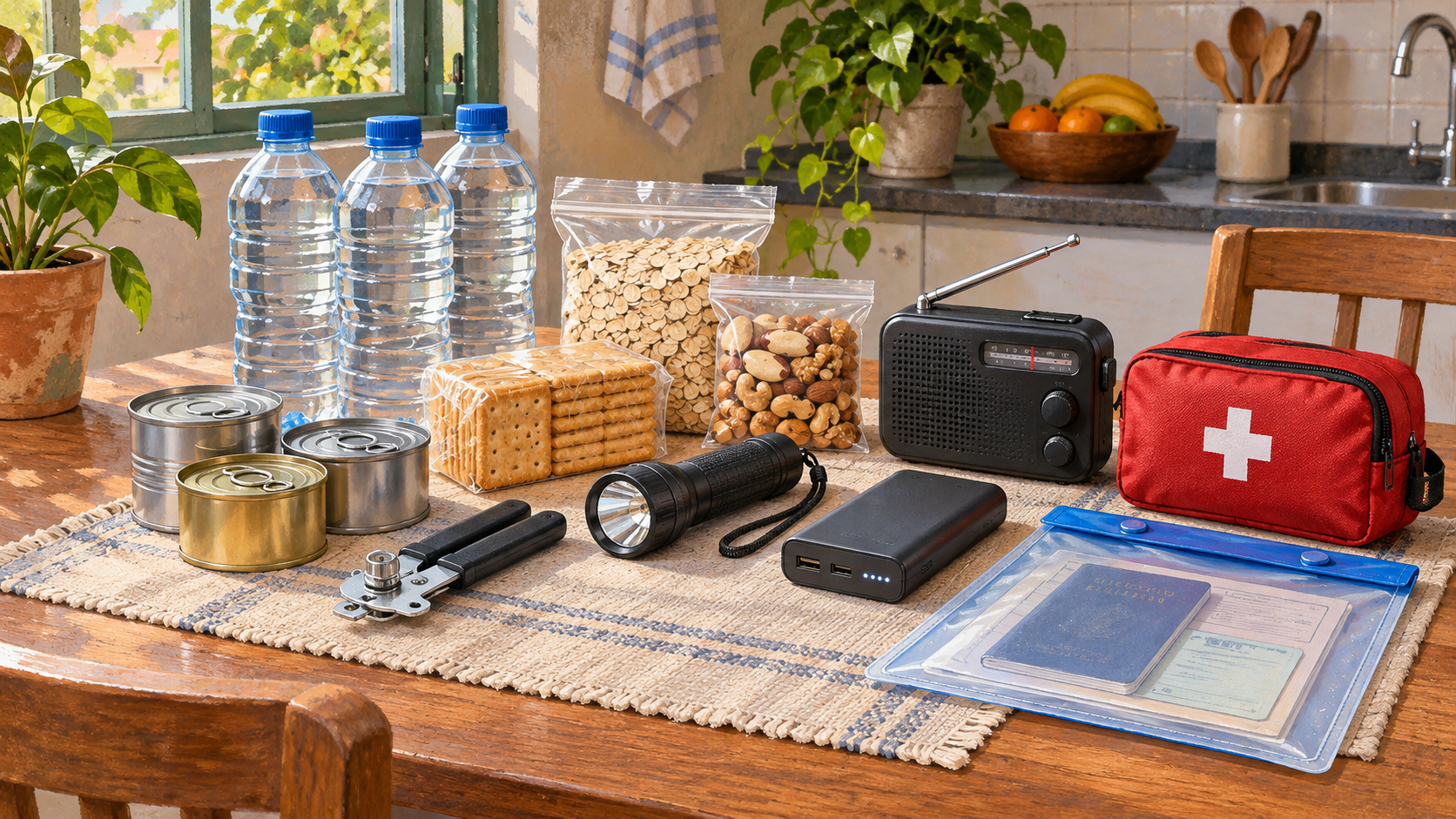
The guidance is to prepare essential items for possible disasters and follow local civil protection warnings. On November 7, Maceió’s civil protection authority, for example, described a kit for up to 72 hours. It includes water, non-perishable food, regular medication, a flashlight, batteries, a power bank and documents protected from water.
In São Paulo state, a state civil protection family emergency plan made available by Itaí’s city government also recommends water and non-perishable food for three days. Preparations should account for children, older people, people with disabilities and pets.
Which countries advise keeping supplies, and for how long?
- Germany: the Federal Office of Civil Protection and Disaster Assistance (BBK) recommends being self-sufficient for ten days where possible. An initial supply for at least three days is useful and can be increased gradually.
- Sweden: an official leaflet published in May 2025 lists food for at least a week, alongside water, lighting, communications and first aid supplies.
- Norway: the Directorate for Civil Protection (DSB) advises enough food for everyone at home for one week. The recommended period increased from three days to a week in May 2024.
- Finland: the government portal Suomi.fi recommends supplies for at least 72 hours, using products households normally consume.
- Denmark: the Danish Emergency Management Agency recommends three days of self-sufficiency. Its guide allows three litres of water per person per day for drinking and food preparation.
- France: the government’s emergency guidance recommends a 72-hour kit to help people cope with the initial difficulties following a disaster.
- Japan: official disaster preparedness guidance recommends food and water for at least three days, preferably a week.
Why do governments make these recommendations?
The European Union’s preparedness strategy, presented in March 2025, included developing guidelines for a minimum of 72 hours of population self-sufficiency. The aim is to improve readiness for crises. It does not mean every country uses an identical shopping list. Source: European Commission.
Norway’s DSB lists extreme weather, pandemics, accidents, sabotage and, in the worst case, war among the scenarios behind its advice. Household preparations also allow emergency services to focus on those most in need. These durations are preparedness targets: they do not predict when a crisis will happen or how long it will last. Source: DSB.
How to build an emergency kit gradually
Practical basics include drinking water, long-lasting food the family already eats, a manual can opener, a flashlight, batteries, a power bank, hygiene supplies, documents and necessary medicines used as directed. Some food should be suitable for eating without cooking or refrigeration.
The Danish guide recommends buying a little extra over time, then using and replacing supplies regularly. Quantities should reflect household size and individual needs. In Brazil, follow local warnings and evacuation orders: having a kit does not make staying in a hazardous area safe.
OnTheNet review of official sources consulted on November 11, 2026. The recommendations were published at different times and do not constitute a joint announcement by the countries.
Leave a Reply
You must be logged in to post a comment.