
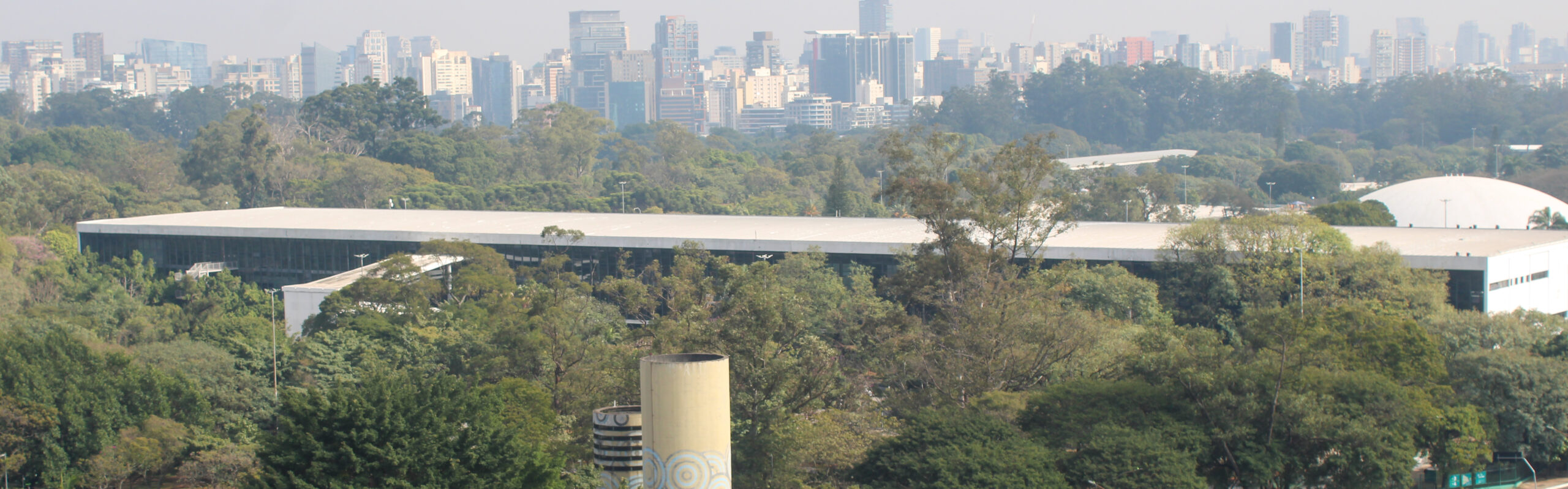



The 36th São Paulo Biennial closed in January 2026 and left one of the most celebrated legacies in the event’s recent history. In fact, the show carried the title “Not All Wanderers Walk Roads – On Humanity as Practice.” Thus, the curatorial concept drew on a verse by Brazilian writer Conceição Evaristo. The proposal treats humanity not as a fixed state, but as a verb in constant construction.
Curatorship and Concept of the São Paulo Biennial
Cameroonian curator Bonaventure Soh Bejeng Ndikung led the general curatorship of the show. He structured the exhibition around the idea of “listening as practice” and the metaphor of the estuary. The estuary represents a meeting point between different currents of water, cultures, and histories. As a result, the team organized the show into six thematic chapters, addressing interconnection, resistance, spatial rhythms, care, transformation, and beauty as a form of political resistance.
The exhibition occupied the Ciccillo Matarazzo Pavilion, in Ibirapuera Park, in São Paulo. The 36th edition ran from September 6, 2025, to January 11, 2026. In turn, that was a month longer than usual, and admission was free to the public. Also, more than 130 artists from different countries took part in the show. Berlin-based studio Yukiko created the visual identity, which drew on polyphonic sound waves. In addition, Gisele de Paula and Tiago Guimarães designed the exhibition architecture, evoking winding banks and the fluidity of an estuary.
National and International Tour of the Exhibition
Part of the program, named “Invocations,” extended beyond São Paulo. Moreover, the initiative included activities in cities such as Marrakech, Guadeloupe, Zanzibar, and Tokyo. Next, the exhibition’s national tour passed through Santos, on the São Paulo coast, between April and June 2026. The stop at Sesc Santos brought together nine artists around the themes of memory, territory, displacement, and resistance. Finally, that stop marked the third time the city hosted a Biennial tour, after the 2011 and 2014 editions.
The organizing foundation, the Fundação Bienal, began in 1951 and became one of the oldest in the world after Venice’s. Thus, the 36th edition reinforced the institution’s role as one of the leading international forums for debate on contemporary art and urgent human questions. Check out more coverage of Brazilian exhibitions and art movements in OnTheNet’s Culture category.


























Leave a Reply
You must be logged in to post a comment.